How One Small AI Team Became the Vision Intelligence Engine for an Entire Equipment Group
A food equipment group's ten-engineer AI team scaled across a growing brand portfolio without adding headcount. The infrastructure that made it possible.
Your customers grade a new crop, a new animal, a new bake every week, and expect the machine to keep up. Add that capability without building the infrastructure yourself. You keep the result. Governed for the life of the model, delivered with our team.
Most of the time that expectation lands on an OEM's product line. Here it lands on an OEM's own AI team. A global food processing and packaging equipment group built through acquisition, an OEM global leader in automation solutions for Food, had the expertise. What it did not have was a way to make that expertise reach every brand in its portfolio without rebuilding the plumbing for each one.
Why does a growing equipment group's AI capability stay stuck in one place?
Because the group did not build vision AI from a blank slate. It inherited it, brand by brand, acquisition by acquisition, each subsidiary carrying its own tools and its own approach to inspection. The expertise that exists sits in one small team, fewer than ten engineers, and that team cannot be teleported into every brand that needs it.
One brand has an in-house data scientist who built something that works on a specific machine. Another still relies on classical machine vision and keeps deferring the AI question. A third started a custom build with an outside partner and hit the wall every such project eventually hits. The end customers of these machines ask the same questions everywhere in food processing: can the inspection system adapt when the product changes? Can it be retrained without calling in a specialist? Can it scale to more lines without rebuilding from scratch? Demand is expanding faster than one small team can answer it alone.
What does patchwork platform development actually cost?
More than engineering time. A small team can maintain a custom stack for one or two contained use cases. It cannot maintain interoperability across a dozen open-source tools once a third brand, a new product variant, and a different crop all land in the same queue at once. The debt compounds with every new project.
The labelling workflow from one project does not interoperate with the training framework from another. Versioning becomes manual. Deployment to a new machine means re-engineering, not reuse. In food processing, where the product changes seasonally and retraining is a recurring job rather than a one-time task, that debt accumulates fast. The commercial cost is sharper still: an equipment group that cannot consistently deliver AI-enabled inspection across its portfolio leaves capability gaps that end customers eventually fill elsewhere, sometimes by sourcing the intelligence layer separately, so the group's own AI investment ends up funding a competitor's pitch.
| Dimension | Patchwork DIY stack | Governed Indurion Suite |
|---|---|---|
| Adding a new brand or use case | Rebuild the stack from scratch | Draws on shared labelling, training, and deployment infrastructure |
| Versioning | Manual, often undocumented | Tracked and governed at every deployment |
| Team capacity ceiling | Two or three active projects | Multiple use cases in parallel, same headcount |
| Who builds the model | The same small team, from zero, every time | The OEM's own team, on infrastructure they did not have to build |
Where does the team's own expertise actually get used, and how?
Inside a platform that was not theirs to build from scratch. The group adopted a Vision AI platform as the foundation for its delivery model on one condition: it had to extend the team's reach, not add to its workload. The first use case built on it was a walnut kernel grading line.
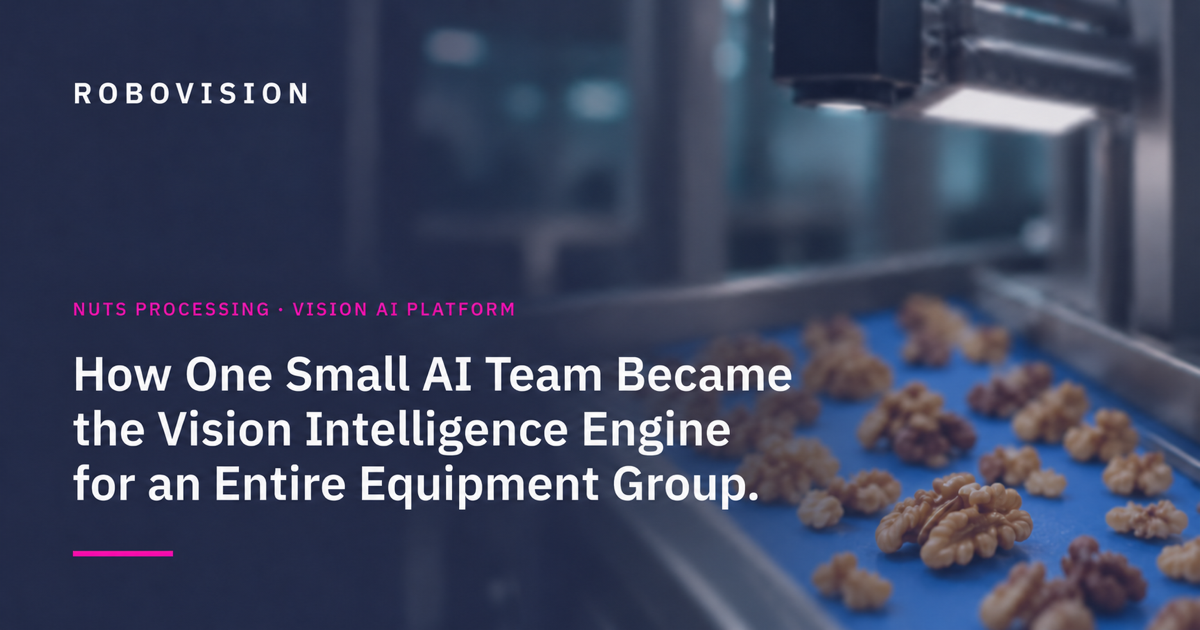
The grader presents a tray of kernels, each pre-cropped by the machine's own processing logic and submitted individually to a defect classification model. The model grades each kernel by completeness, whole, half, or piece, and flags defects such as mold or insect damage, up to 100 kernels per tray in under ten seconds, across five quality classes. The AI team built and trained that model themselves, inside the Indurion Suite's labelling and training environment. The division of labor runs opposite to a line where Robovision builds the model: the OEM's own team owns the model and the domain expertise, and the Suite owns the deployment path and the versioned governance record underneath it. End customers choose between running inference locally or calling the platform's cloud API.
What does scaling to a second use case without adding headcount prove?
That the constraint was never talent. It was infrastructure. A second use case, blueberry sampling using near-infrared and RGB imaging, runs in parallel on the same platform and the same small team, delivered without additional headcount. That is a test a demo cannot run: two use cases, one team, at the same time.
The architecture behind both deployments is a central hub governing model creation, training, and versioning, with agents deployed at the machine level. Each new brand or use case that gets added draws on that same infrastructure instead of a stack assembled from scratch for the occasion. The subsidiary's own technical leadership credits the platform with consolidating what had been dozens of separate vision projects into one environment, letting a small team punch above its weight. The technical debt that comes from patchwork development does not get a chance to accumulate, because there is no patchwork left to accumulate it.
What does this mean for OEMs inside a multi-brand group?
That a small, expert AI team with the right infrastructure underneath it can serve a portfolio far larger than its headcount suggests. Without that infrastructure, the same team becomes a bottleneck, capable, but unable to scale. The difference between those two outcomes was never a question of talent. It is a question of infrastructure.
For OEM decision-makers weighing build versus buy on an AI and MLOps stack, the evaluation question is not whether a small internal team can be technically capable. It usually already is. The question is whether that team's expertise can reach every brand in the portfolio without being absorbed by platform maintenance instead. You keep the result. We run the lifecycle for you.
See how governed vision AI runs in food production
Codified grading, continuous retraining and an audit trail, on the line you already run.