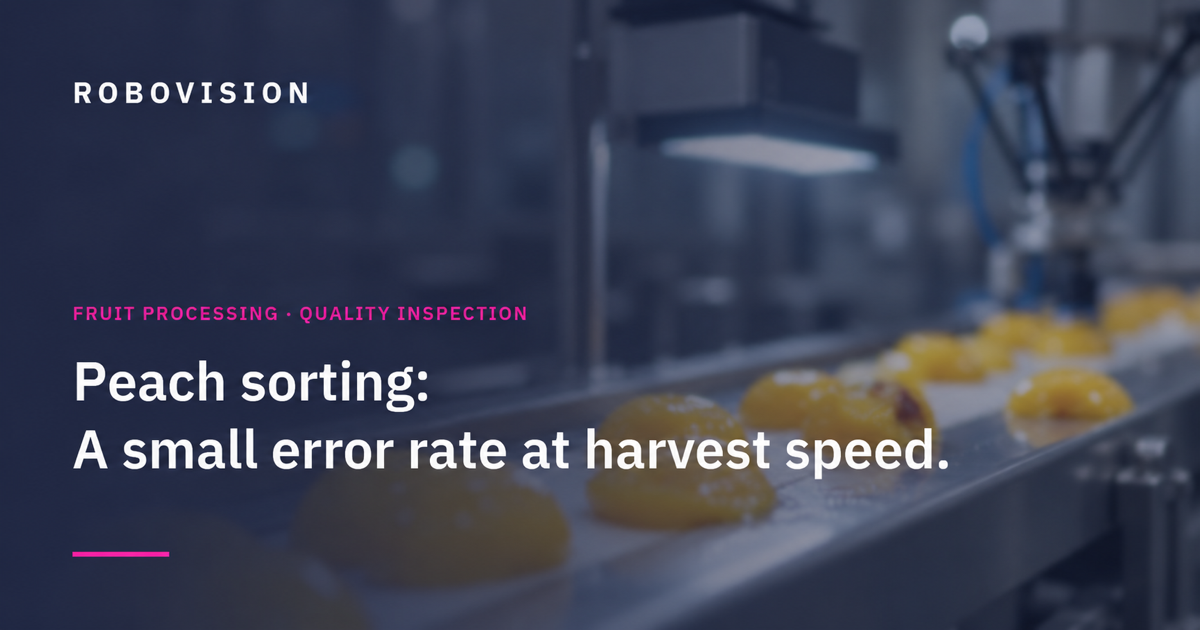
Peach Sorting: A Small Error Rate at Harvest Speed
A sorting error rate that looks trivial by hand becomes the business risk that decides contract renewals once a peach line hits harvest speed.
Your customers grade a new crop, a new animal, a new bake every week, and expect the machine to keep up. Add that capability without building the infrastructure yourself. You keep the result. Governed for the life of the model, delivered with our team.
Peaches make that expectation literal. A harvest window that opens for a few weeks a year, a line that has to run at industrial speed the moment it opens, and a sorting decision that has to be right on the first piece of fruit as much as the millionth. An error rate that looks small on a spec sheet turns into a very different number once you multiply it by the volume a harvest actually moves.
Why does harvest season break manual peach sorting?
Because the two things a peach line needs together, speed and judgment, don't scale the same way. A trained sorter can assess a few hundred pieces a minute under good conditions. A processing line at full harvest throughput has to move far faster, for shifts that outlast anyone's attention span, for weeks that don't pause for a training gap.
For generations the answer was people: experienced sorters who knew, by sight, which peach met grade. That answer depended on a workforce that showed up, stayed sharp for eight hours, and returned the next season with the same judgment. Across fruit processing, that dependency is breaking. Seasonal, often migrant, labor is harder to recruit and retain every year, and the standards that are clear in a training session blur once the line is running at full speed. The gap between what the line demands and what a tired shift can deliver doesn't announce itself. It shows up downstream, as a quality complaint or a rejected pallet.
What does a rule-based system miss as the season moves?
It misses the drift. A static system calibrated once, on the fruit available at the start of the season, keeps applying those same criteria as ripeness, color, and defect patterns shift through the harvest. Peaches six weeks in look different from peaches on day one. The rule doesn't know that. It keeps scoring against the wrong reference.
The resulting failure isn't dramatic. It's gradual and largely invisible: good fruit gets rejected, marginal fruit gets passed, and because the errors are spread across thousands of individual decisions over a season, nothing forces a review until a retailer audit or a customer complaint traces back to it. For an OEM supplying the sorting equipment, that is the harder problem. The machine can be running exactly to specification while the inspection intelligence sitting on top of it, human or fixed rule set, is quietly drifting away from what the season now looks like.
| Dimension | Manual sorting at harvest scale | Governed AI vision (Indurion Suite) |
|---|---|---|
| Throughput | A few hundred pieces a minute, ideal conditions | Over 1,000 peaches a minute, per line |
| Consistency across a shift | Degrades with fatigue and shift changes | Same criteria applied to every peach |
| Adaptation across a season | Informal, inspector by inspector | Retrains on production data as the season moves |
| Failure mode | Gradual, surfaces in a complaint or audit | Logged and versioned at every decision |
Where does detection have to happen, and what does it?
At the conveyor, on every peach, before the reject point. An object detection model locates each piece of fruit in real time and classifies what it finds against defined quality criteria, then hands that classification to the robotic arm that removes it from the line, before the next peach arrives.
The Indurion Suite, coupled with the OEM's platform called STAQ, trains, deploys, and governs that model: an object detection model that Robovision retrains as the season's fruit changes rather than a rule set calibrated once. It returns a center point and coordinates for each peach and classifies it into defect classes, surface damage, a crushed section, a kernel fragment left after processing. The division of labor is deliberate. Robovision owns the model and the record of every decision. The OEM owns the physical system: the conveyor, the lighting, the robotic arm, the PLC that executes the reject. The Indurion Suite doesn't release product on its own. It tells the line what it found.
What did scaling from one line to eight actually prove?
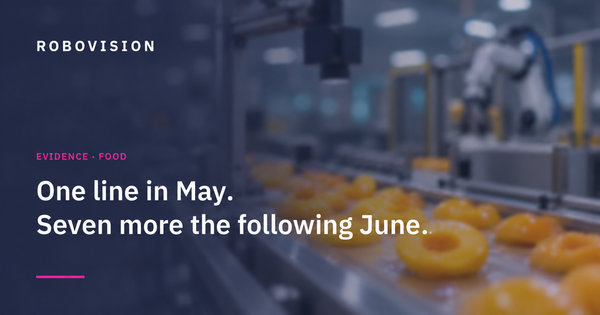
That the model held up across two full seasons, not a single trial. A fruit processor, Agrophoenix, running the Robovision Indurion Suite with partner QING, put one line into production, watched it through two harvests, and then ordered enough systems to cover the whole operation. That is a commercial decision, not a technical one.
Each line inspects over 1,000 peaches a minute. Across the full deployment, now eight systems, that adds up to 500,000 peaches inspected an hour, with each robot picking up to 80 pieces a minute. The system has reached a 97% pick rate, improved quality consistency by 85%, and removed the need for 40 full-time workers a day on the sorting step. None of that came from a single calibration session at commissioning. It came from a model that kept learning from production data as the season, and then the seasons, moved.
What does this mean for OEMs supplying this sector?
That harvest is not a one-time problem to solve. It repeats every year, with a new ripeness curve, a new defect mix, and the same seasonal labor gap. A system calibrated once and left alone decays on the same calendar the harvest does. What holds up is a model that keeps learning from every season it runs.
For OEMs and system integrators building sorting equipment for this sector, the evaluation question isn't whether a vision system can hit a pick rate number in a demonstration. It's whether the system your customer buys this year is still the right system three harvests from now, without a site visit to recalibrate it. You keep the result. We run the lifecycle for you.
Full deployment details: https://robovision.ai/what-we-do/vision-ai-automation-in-food-production-and-processing