One Line in May. Seven More the Following June.
Every vendor can show you a benchmark from day one. The number that matters is harder to manufacture: what did the customer do after living with the system through a real production year?
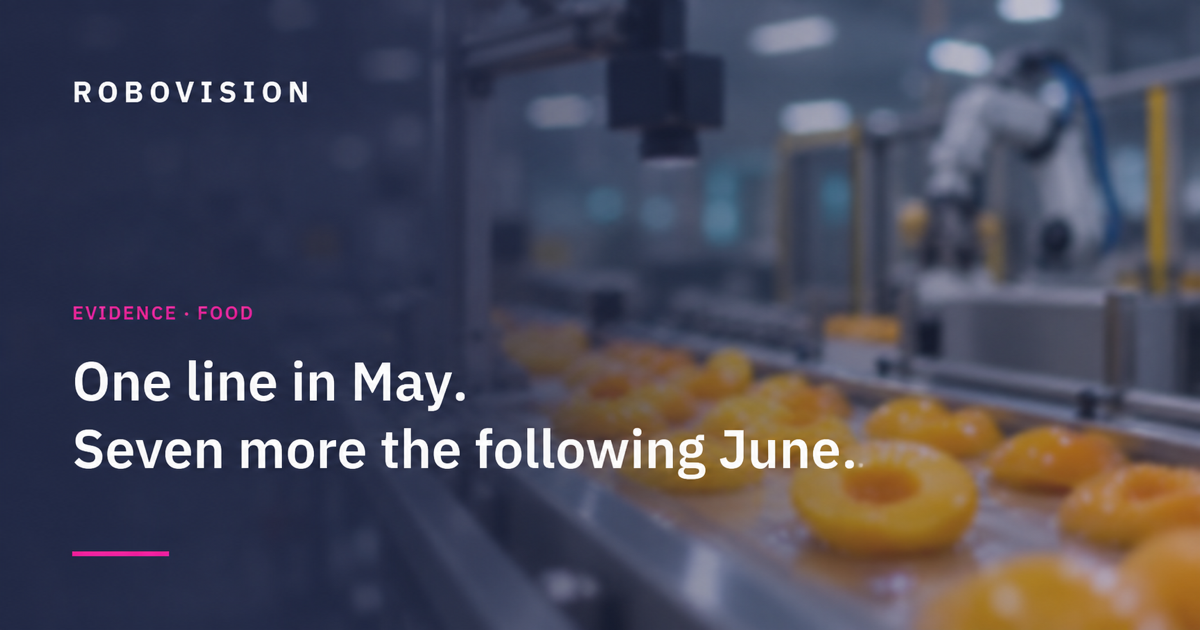
Every vendor can show you a benchmark from day one. The number that matters is harder to manufacture: what did the customer do after living with the system through a real production year?
Agrophoenix, a Greek fruit processor, answered that with a purchase order. One line live in May 2024. Ten months of operation. Then seven more lines, live in June 2025. This is what that arc looked like from the inside, together with our partner QING, the Dutch engineering and automation company that built the line.
What did day one look like?
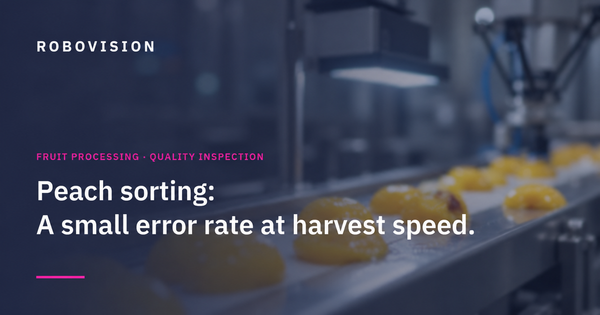
Agrophoenix runs peach processing at industrial scale, and faced the pressures every producer will recognize: sorters hard to recruit and retain through peak season, rising wage costs, high turnover, and the need to hold consistent quality while demand grows.
QING built the sorting cell, lighting, cameras, robotics, and conveyor, integrated with the Robovision AI Platform, and validated it on a dedicated test rig built to defined technical specifications before anything touched production. The object detection model was developed on 4,000 images across 3 to 4 labeling iterations; the implementation of the Robovision Agent took 10 mandays. In production, the line identifies and sorts out substandard fruit, leftover kernels, crushed fruit, at over 1,000 peaches per minute, and reduced labor cost by 2 FTE.
What happened between day one and day 300?
Ten months of seasonal production. Peaches are biology: ripeness windows, variety changes, the shift in what "substandard" looks like as the season moves. This is the stretch where vision systems traditionally earn their reputation, one way or the other, and where the difference between a demo and infrastructure becomes visible on the scrap line and the reject belt.
The measure of those ten months is not a number we could publish; it is what Agrophoenix did next.
What does the repeat order actually prove?
A company that has operated a system through a full production cycle holds evidence no evaluation can generate: real uptime, real drift behavior, real support experience, real economics. Ordering seven more lines on that evidence is the strongest statement available in industrial procurement. It says the system held on day 300 what it promised on day 1, at the one desk where that claim gets audited hardest: the buyer's own P&L.
For QING, the deployment demonstrates something equally durable: an engineering partner shipping AI-grading capability without standing up an MLOps operation of their own, the platform carrying the model lifecycle while QING owns the machine. In the words of Teun Keusters, QING's Lead Engineer Deep Learning, the platform lets food production companies use the application themselves without relying on outside expertise.
What should a producer take from this?
That the evaluation question is wrong most of the time. Not "how accurate is the model," but "what will I know after ten months, and what will I do about it." Agrophoenix knew enough to multiply by seven.
You keep the result. We carry the risk of the model.
Full partner case and deployment details: robovision.ai/what-we-do/vision-ai-automation-in-food-production-and-processing